

SolidStart 1.0: The Shape of Frameworks to Come
Official SolidStart Version 1.0 release announcement.

The role of Server Rendering in JavaScript is growing. In pursuit of performance and optimization, everything points to leveraging the server more.
It is also clear that it isn't getting any easier to get started with this technology. People were having a hard enough time as it was with their webpack configs. And now we needed to do a lot more to play nicely on the server.
Something needed to be done, but it needed to be done right. Something easy enough that one could get started without much effort but not so opinionated that you are stuck on specific technologies. The solution needed to appeal to everyone and not fracture our growing ecosystem.
Fortunately, Vite 2.0's release showed the way this could be done and the rest was history...
Or that's what I would like to say. But the truth was there was still a lot more to figure out. Multiple rewrites, 2 Beta phases, and a lot of learning. But 3 years later we have reached our first major release.
What is SolidStart?
SolidStart is a JavaScript Framework designed to build Solid apps and deploy them to a variety of providers. This doesn't sound all that different from most other JavaScript frameworks. But the devil is in the details.
Everything is à la carte
SolidStart is designed first and foremost to be a starter. This means that the basic setup without installing any libraries produces Hello World examples that are ~5kb JavaScript Minified and GZipped. Don’t want to use additional libraries? Don’t worry, you don’t have to.
SolidStart’s base does not lock you into any specific conventions. Adopting some of the ones we provide in SolidStart will often provide the best experience but it isn't mandatory to pay the price for features you don't need.
Bring your own Application Router
SolidStart does have Filesystem routing. It uses similar conventions to Nuxt where parameters are passed via []. However, we also use () as a way to do more powerful things like Route Groups, named index routes, and as a way to break out of nesting. Basically whatever you put between the parenthesis is removed from matching, but still impacts the structure of your routes.
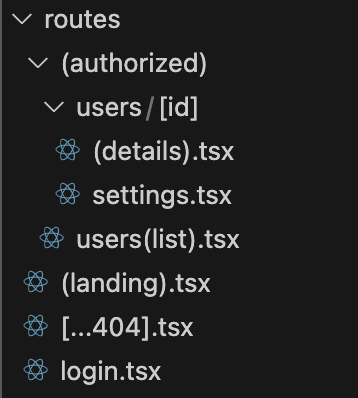
The configuration that we get from the File System is then passed back to the application to be used in the router of your choice. You can call FileRoutes as a component or a regular function to get the configuration generated by SolidStart.
import { FileRoutes } from '@solidjs/start/router';import { Router } from '@solidjs/router';
function App() {  return (    <Router>      <FileRoutes />    </Router>  );}
How do you configure your routes? Our route export lets you define your custom route config. We automatically lazy wrap the default exported component and add it to your config under the component property.
import { type RouteDefinition } from "@solidjs/router";import { getStory } from "~/lib/api";
export const route = {  load({ params }) {    void getStory(params.id);  },  matchFilters: {    id: /^\d+$/ // only allow numbers  }} satisfies RouteDefinition;
export default function MyRouteComponent() {}
You can set your own types and use the router of your choice, configured how you want in your projects.
The Server Enhances (No Rewrites Here)
SolidStart was built as "Single Page App" first. Every feature is designed to work with all the libraries you already use. To do so required us to carefully consider how we added server-only capabilities.
This is what lead us to pioneering "Server Functions" in early 2022, a feature that has since made its way into several popular frameworks.
By adding "use server"; to a function it is only executed on the server, either being naturally called on the server or used as an RPC from the client. Server functions are transparent from a TypeScript perspective and can fit into your existing APIs, like fetchers in Tanstack Query.
import { createQuery } from "@tanstack/solid-query"
function Posts() {  const query = createQuery(() => {    queryKey: ["posts"],    queryFn: async () => {      "use server";      const evt = getRequestEvent();      if (!evt.locals.userId)        throw new Error("Not Logged In");
      const posts = await db.posts.getMany({        where: { userId: evt.locals.userId }      })      return posts;    }  });
  return /* ... */}
In this way, everything works the way you'd expect on the server and client during initial SSR or during future navigation. Whether you are fetching data or doing mutations. And even if you are purely doing client-side rendering in the browser.
Our server functions support advanced serialization for this like Async Iterables, Streams, and Promises ensuring you build the APIs you want.
We've used this capability to do things like Single Flight Mutations with Solid Router's API which lets the server start fetching the data for the next page after an update and stream it back on the same response while the client handles the redirect. Between this, parallelized load/cache patterns, and Solid's non-blocking Async, we've all but eliminated unnecessary waterfalls.
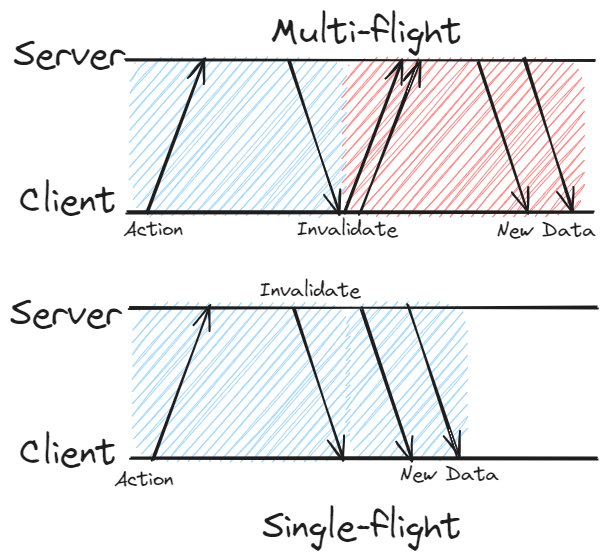
You can see this in our Notes example.
Onward & Upward
Honestly, there are too many features to talk about with SolidStart because your experience is exactly what you make it. Client Render Mode, Server Side Rendering, Static Site Generation, Out-of-Order-Streaming, Optimistic UI, Key Based Cache/Invalidation, Progressively Enhanced Forms, API Routes, Parallelized Nested Route Data Fetching, Single Flight Mutation, Islands(experimental), Suspense, Transitions. The list goes on.
This is a framework designed for builders and people who have their own opinions. We're only beginning to tap into the potential here. That's what we mean by "The Shape of Frameworks to Come". SolidStart won't be the last Solid Framework. We're just getting started. We've already seen people build Meta-Frameworks on top of it like CreateJDApp and MediaKit.
And for that, we (the Solid Core Team) are incredibly thankful. Thankful for all the contributors submitting issues and PRs. Thankful for open-source projects that make this technically possible like Vite, Vinxi, and Nitro. Thankful for all the sponsors contributing funding like Netlify, Google Chrome, and JetBrains. Most importantly we're thankful to all of you for embracing development in the open, choosing better over convenient, and sticking with us on this journey. You inspire us to keep building the best solutions we can and to continue to shape the future of web development.
Thanks to Theo Browne, Erik Demaine, Dev Agrawal, and bigmistqke for reviewing this article, and Dev Agrawal for providing the Single Flight Mutation image.